
01
System goalDescribe the intelligence in plain language
The goal is easy to understand: four sensor values enter a tiny analog engine, three candidate classes compete, and the highest voltage becomes the prediction.
Explore analog, mixed-signal, sensor, power, and analog-compute systems across operating-point, DC, AC, transient, noise, stability, and tolerance studies—with equations, waveforms, and model limits connected.
Analog and mixed-signal circuits
Transient and frequency response
Model-to-circuit verification
Example study
This real study is simple enough to explain without circuit jargon, but rich enough to exercise architecture, signed-weight encoding, transient behavior, numerical verification, margins, robustness, and provenance.
6 / 6
Every managed transient case selected the expected class
359.75 mV
Smallest winning-voltage separation in the ngspice result
1.44 mV
Largest analytical-to-simulated score difference
ngspice 45.2
2,644 parsed transient samples with job provenance
01
System goalThe goal is easy to understand: four sensor values enter a tiny analog engine, three candidate classes compete, and the highest voltage becomes the prediction.
02
ArchitecturePositive and negative weights become paired conductances in a differential resistive crossbar. Current summation performs the dot products in the circuit itself.
03
Circuit modelVicena collapses the crossbar, finite-gain transimpedance amplifiers, pulse sequence, measurements, and outputs into a self-contained ngspice input.
04
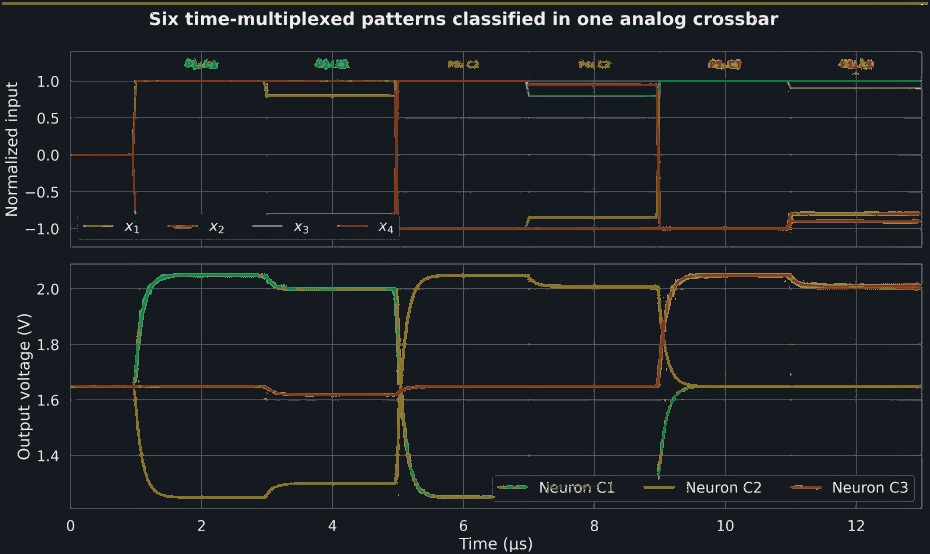
Managed computeOne managed job applies six time-multiplexed sensor patterns and records all three neuron voltages as the circuit settles and changes its decision.
05
EvidenceThe notebook compares expected and simulated class scores, checks the winning class, measures decision margins, and quantifies model deviation instead of showing only a plausible waveform.
06
Next designAnalytical sensitivity studies vary resistor tolerance and inference time to reveal which conclusions came from the remote solver and which are design estimates.
Real workflow artifacts
The figures connect the physical architecture to the changing input pattern, competing class voltages, numerical reference, and design limits. They come from one executed analysis record—not disconnected marketing illustrations.
The upper panel shows the changing sensor pattern; the lower panel shows the three physical neuron voltages competing over time.
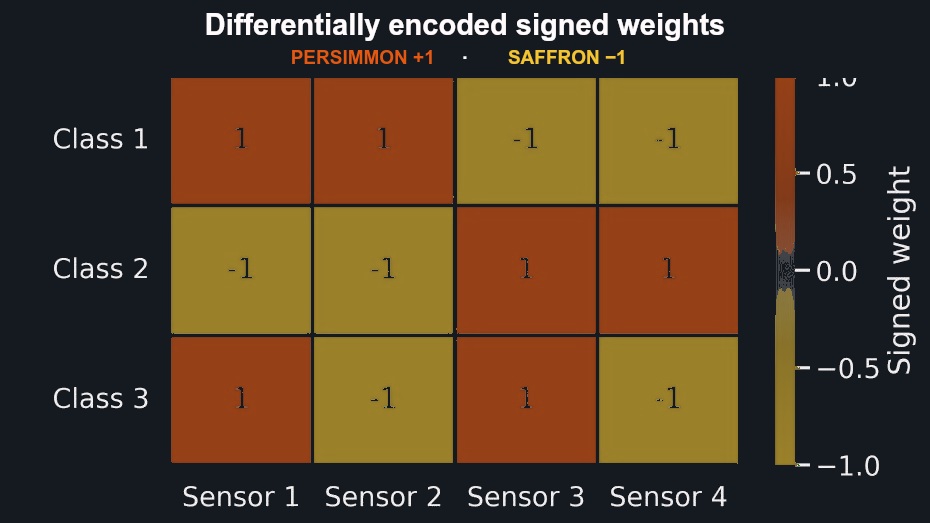
Persimmon and saffron identify the +1 and −1 differential-conductance encoding for every sensor-to-class connection.
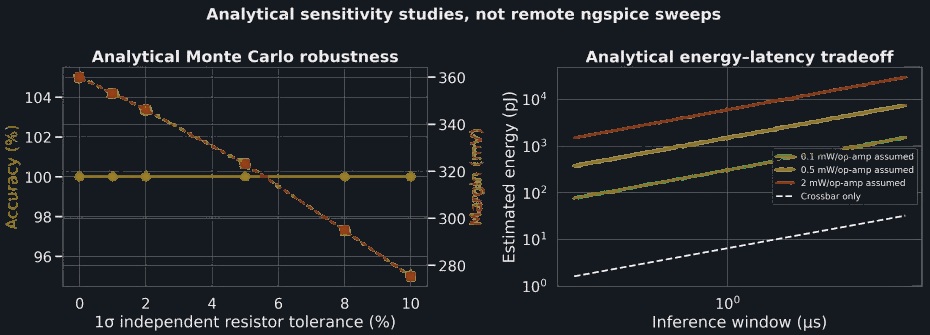
The tolerance and energy panels are analytical follow-on studies—not remote Monte Carlo or transistor-level power results. That distinction stays attached to the figure.
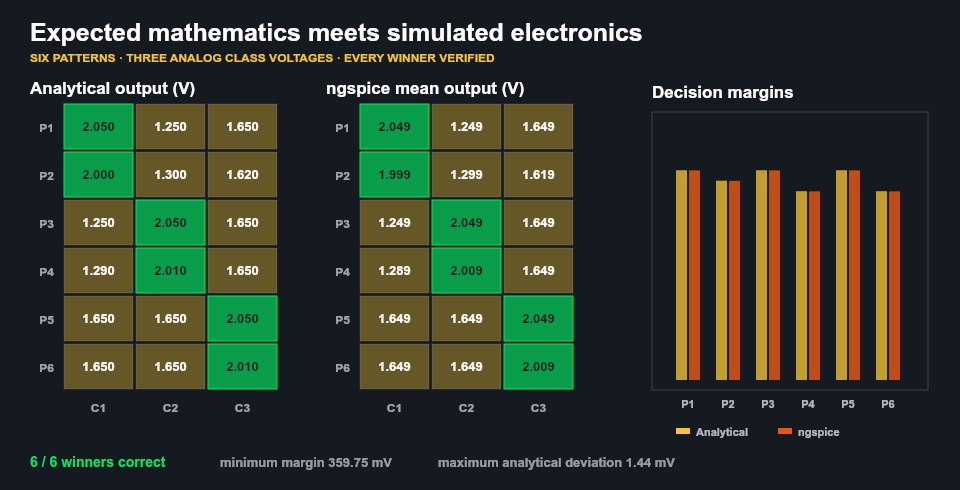
Analytical and ngspice score maps agree within 1.44 mV, while all six winner margins remain visible rather than hidden behind an accuracy number.
Scientific packages

45.2
Circuit simulation
Runs operating-point, DC, AC, transient, noise, Fourier, and measurement-driven analyses for analog and mixed-signal circuits.
Official project
2.10
Device-to-circuit modeling
Connects semiconductor-device physics to electrical characteristics that can inform compact models and circuit studies.
Official project
Numerical verification
Checks equations, parses solver outputs, compares expected and simulated behavior, and supports parameter and sensitivity studies.
Official project
Inspectable analysis
Keeps circuit inputs, equations, waveforms, tables, plots, limitations, and follow-up calculations in a reusable notebook.
Official projectScientific capabilities
Vicena can reuse reliable circuit workflows for familiar tasks, then build a bounded new study when the topology, model, or measurement is different.
Explore amplifiers, filters, oscillators, converters, sensor front ends, power stages, and architecture-level analog computing.
Run operating-point, DC, AC, transient, noise, Fourier, and measurement-driven studies with inspectable waveforms.
Compare expected equations with simulated voltages, currents, decisions, margins, settling, and sensitivity.
Study component values, tolerances, bandwidth, energy, stability, sensing range, and competing circuit architectures.
Evidence discipline
The headline is six correct classifications. The scientific value is that every intermediate score, expected value, margin, model assumption, solver version, and artifact can still be inspected.
Scientific boundary
Start with your design
Describe the function and constraints. Vicena can turn them into a model, run the appropriate analysis, and return both the visual result and the evidence behind it.