
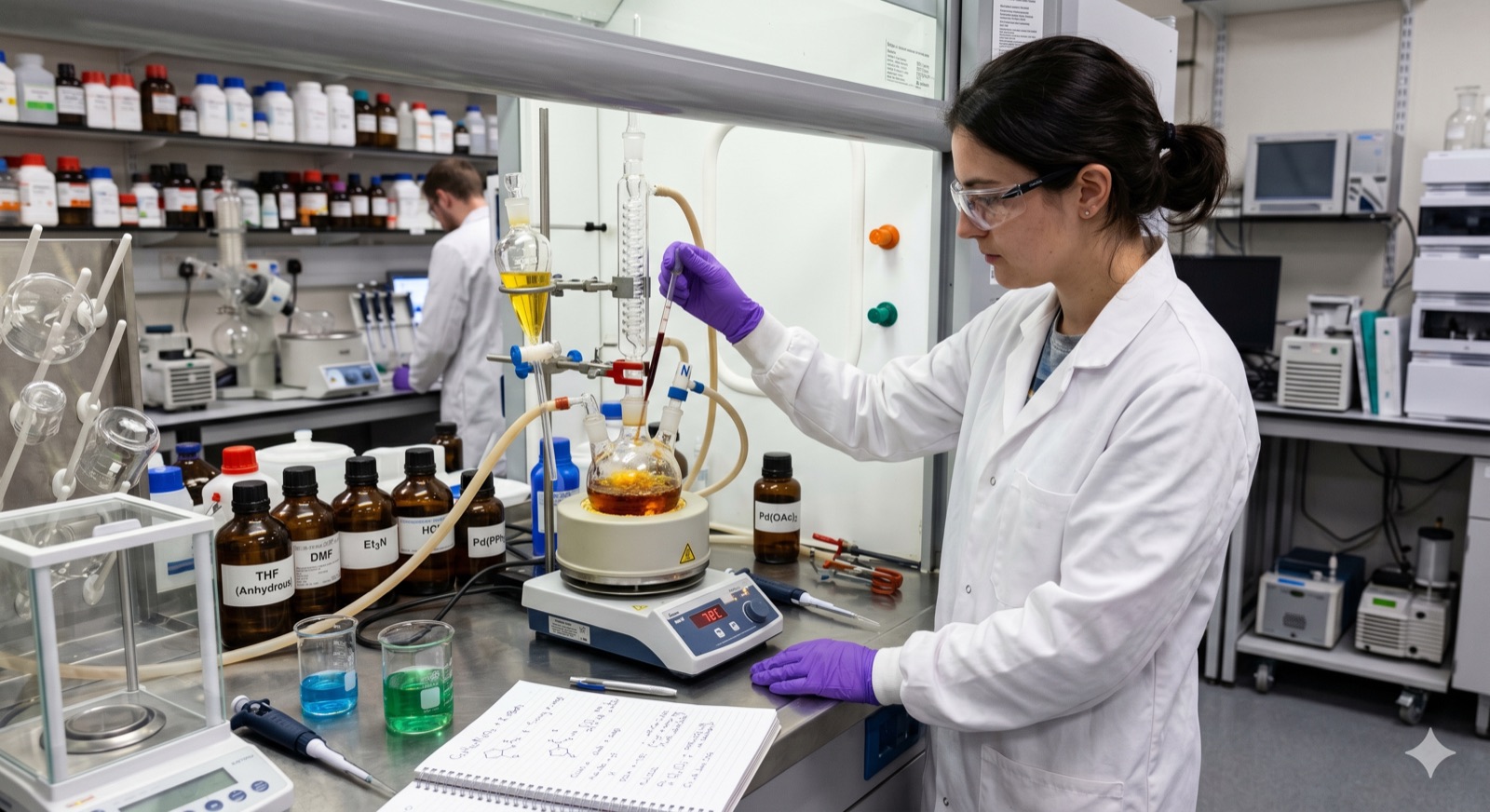



Síntesis, protocolos, herramientas químicas, cuadernos y cómputo

IA para trabajo químico.

Planifica rutas de síntesis, diseña experimentos, audita protocolos, analiza compuestos y reacciones, y pasa a química computacional cuando el trabajo necesita simulación.

Planifica rutas, diseña experimentos y audita protocolos antes del laboratorio.

  • Planifica rutas, diseña experimentos y audita protocolos antes del laboratorio.
  • Analiza compuestos, riesgos, solubilidad, espectros, descriptores y similitud en un solo flujo.
  • Revisa reacciones por productos, balance, compatibilidad, energética, cinética y brechas.
  • Pasa de preguntas químicas a cuadernos y cómputo con Rowan cuando sea necesario.
  • Convierte artículos, protocolos, moléculas y resultados de ensayos en decisiones de siguiente paso.
  • Las respuestas respaldadas por herramientas devuelven evidencia y brechas de cobertura, no falsa certeza.
Crea borradores operativos y luego audítalos por factibilidad, seguridad y brechas.
Flujos de protocolos

Crea borradores operativos y luego audítalos por factibilidad, seguridad y brechas.

Balance, compatibilidad, predicción, energética, cinética y límites.
Inteligencia de reacciones

Balance, compatibilidad, predicción, energética, cinética y límites.

Ejecuta descriptores, pKa, confórmeros, docking y cuadernos de simulación.
Modelado computacional

Ejecuta descriptores, pKa, confórmeros, docking y cuadernos de simulación.

Identidad, propiedades, riesgos, solubilidad, espectros y brechas de datos.
Inteligencia química

Identidad, propiedades, riesgos, solubilidad, espectros y brechas de datos.

Trabaja hacia atrás desde moléculas objetivo para encontrar rutas sintéticas factibles.
Retrosíntesis

Trabaja hacia atrás desde moléculas objetivo para encontrar rutas sintéticas factibles.

Estequiometría validada, soluciones, pH, presión de vapor y presión de gases.
Calculadora química

Estequiometría validada, soluciones, pH, presión de vapor y presión de gases.

Usado por investigadores en universidades líderes, laboratorios y equipos técnicos.

MITStanfordHarvardOxfordCambridgeCaltechETH ZurichTsinghuaGoogleNASACERNMax Planck1000+ institutes

Espacio de química

Un punto de entrada para el trabajo químico, con páginas más profundas cuando las necesites.

Usa esta página como entrada a química: planificación de síntesis, diseño experimental y de protocolos, respuestas con herramientas, cuadernos y cómputo. Las páginas profundas explican cada área sin cargar esta página con todo.

Respuestas respaldadas por herramientas, no suposiciones sin soporte.

Cuando Vicena necesita un peso molecular, punto de ebullición, código GHS, producto de reacción o resultado de modelado, llama a la herramienta adecuada y mantiene la evidencia visible. Si una herramienta no puede verificar algo, la respuesta lo dice.

🔬

Fuentes en cada número

Los pesos moleculares vienen de RDKit. Los puntos de ebullición, de Thermo. Los riesgos GHS, de PubChem. Cada valor cita la biblioteca y función que lo produjo para que puedas verificarlo o repetirlo.

⚖️

Brechas de cobertura, no falsa seguridad

Cuando una herramienta no tiene datos para tu compuesto, devuelve una brecha de cobertura, nunca una falsa ausencia de riesgo. El agente puede razonar con conocimiento químico, pero lo marca como razonamiento, no como resultado verificado.

🔗

Respuestas multiherramienta en un solo prompt

Una auditoría de protocolo puede llamar herramientas de rendimiento, balance atómico, compatibilidad, ebullición y seguridad. El agente elige qué ejecutar, en qué orden, y lee las salidas para producir la respuesta final. Tú describes el problema una vez.

Superficie del producto

Qué cubre el espacio de trabajo de química.

El agente puede empezar con un objetivo químico práctico y pasar por herramientas locales, cuadernos, flujos de protocolo o cómputo externo según lo requiera la tarea.

NUEVO Protocol Builder + Audit icon

Constructor y auditoría de protocolos

Redacta primero y luego verifica.

Protocol Builder separa pasos respaldados por fuentes de supuestos. Protocol Audit formaliza el procedimiento, genera obligaciones de prueba y registra hallazgos, brechas, supuestos y procedencia como certificado.

Chemistry Calculator icon

Calculadora química

Química cuantitativa acotada.

Estequiometría, rendimiento teórico, preparación de soluciones, dilución, pH, equilibrio simple, presión de vapor y gases ideales. Las constantes faltantes o especies ambiguas producen errores de validación, no conjeturas.

Chemical + Reaction Intelligence icon

Inteligencia química y de reacciones

Paquetes de evidencia para razonamiento del agente.

Chemical Intelligence resuelve identidad, propiedades, riesgos, solubilidad, espectros y similitud. Reaction Intelligence añade interpretación, predicción, balance, compatibilidad, energética, cinética y brechas explícitas.

ROWAN ⚛️

Química computacional

Modelado centrado en cuadernos, con Rowan cuando hace falta.

La IA crea un cuaderno visible para descriptores, pKa, confórmeros, DFT, docking, dinámica molecular y otras tareas. Algunos flujos avanzados usan Rowan mediante Vicena Compute y límites de crédito.

Explorar química computacional

Qué puedes hacer

Tareas prácticas de química, desde planificación hasta cómputo.

Cada escenario es una tarea química real. Mira qué hace el agente, qué devuelve y a qué área del producto puede pasar.

01

Antes del laboratorio, sabe si tu protocolo realmente funciona.

You pull a synthesis from a paper or design one yourself. You're about to commit time, reagents, and glassware. Vicena reads your protocol, checks the math, flags incompatibilities, and cites what it found, in about 30 seconds.

Qué ves

A step-by-step audit showing theoretical max yield vs. your claim, atom balance, boiling points of solvents vs. reflux temperatures, GHS hazards for each reagent, and compatibility concerns (bleach + ammonia, HF + glass, chlorinated solvent + polycarbonate). Every number cites the library it came from. Anything it cannot verify is marked as a coverage gap, not glossed over.

Qué ahorra

Half an hour of manual SDS review, one "wait, is this yield actually possible?" embarrassment in group meeting, and the reagents you would have wasted running a protocol that could not work.

02

From a paper in your hand to a runnable protocol.

Papers, supporting information, and patents often bury the method in dense prose. Vicena extracts variables such as temperature, concentration, duration, and reagents, cross-references them against the source claims, and flags anything inconsistent or incomplete.

Qué ves

A structured protocol with every parameter labeled, a confidence score for each value, and the page/paragraph it came from. Ready to paste into your lab notebook.

Qué ahorra

The hour you would have spent reading methods sections three times because the supplementary has different numbers than the main text.

03

Reaction products, without guessing.

For patent-common reactions such as Suzuki, Buchwald, Heck, amide coupling, and Fischer esterification, Vicena can call a trained reaction model. For textbook reactions such as SN2, acid-base, and simple esterification, it can use deterministic rules. You get the predicted product, the method used, and a clear reliability boundary.

Qué ves

The predicted product as SMILES and structure, the method that produced it, and where the prediction is expected to be reliable vs. where it is not.

Qué ahorra

Mental bandwidth on the reactions where the answer is already known, so you can spend your thinking on the ones that are not.

04

Drug-likeness and scaffold analysis in one prompt.

Paste a SMILES. Get LogP, MW, HBD, HBA, TPSA, rotatable bonds, Lipinski pass/fail, Veber pass/fail, and Tanimoto similarity to the reference compounds you choose.

Qué ves

A full descriptor table with rule-based assessment, plus similarity scores against your reference set with scaffold analysis.

Qué ahorra

Five tabs of SwissADME plus manual fingerprint comparison, with consistent methodology and structured output.

05

Computational chemistry without the boilerplate.

You want descriptors, pKa, conformers, a HOMO-LUMO gap, an optimized geometry, a dipole moment, or a vibrational spectrum. Ask in plain language. Vicena creates the notebook, chooses the right local or Rowan-powered workflow, runs within budget limits, and returns the numbers.

Qué ves

A Jupyter notebook with the inputs, workflow UUID when Rowan is used, results with proper units, tables, plots, CSV files, and comparison against reference values where available. The notebook persists: you can modify it, extend it, or cite it in your methods section.

Qué ahorra

The setup time for input files, polling, descriptor extraction, and plotting for a single modeling question.

Nota de aplicación

Planificación de síntesis con Vicena.

Mira cómo Vicena convierte un objetivo químico en planificación estructurada, revisiones con herramientas y un artefacto listo para decidir.

Prompts de ejemplo abajo. Haz clic en uno para ejecutarlo.

Example prompts

Qué puedes pedir.

Five categories, three prompts each, from quick lookups to multi-step workflows. Click any to open a fresh chat with that prompt.

🧪

Seguridad de laboratorio

Riesgos GHS, revisiones de compatibilidad y auditoría de protocolo.

Usos PubChem GHS + curated compatibility rules
🌿

Química verde

Solvent selection with safety cross-checks. Atom economy and yield analysis.

Usos LogP solvent ranking + ChemPy stoichiometry
📚

Inteligencia de compuestos

Identity, structure, physical properties, hazards, solubility, spectra, descriptors, and similarity.

Usos PubChem + RDKit + Thermo + SMARTS + Morgan fingerprints
🧬

Inteligencia de reacciones

Forward products, retrosynthesis, balance checks, compatibility, energetics, and kinetics.

Usos ReactionT5v2 + RDKit + ChemPy + Thermo + compatibility rules
⚛️

Química computacional

PySCF notebooks plus Rowan-powered molecular modeling through Vicena Compute.

Usos PySCF + Rowan via Scientific Simulations

Some examples run on the free tier; notebook and Rowan-powered workflows require Plus or Ultra.

Flujos completos

Describe el problema. El agente encadena las herramientas.

Cada flujo es un problema real que los químicos resuelven a diario. Haz clic en un ejemplo para abrirlo en un chat nuevo.

🔬

Audita mi protocolo de síntesis

Detecta rendimientos imposibles, combinaciones inseguras y riesgos silenciosos antes del laboratorio.

Chains Auditoría de protocolos Resumen de seguridad Chemical Analyzer
🧬

Plan a synthesis for a target

Retrosynthetic routes with literature backing and predicted yields.

Chains Retrosíntesis Revisión bibliográfica Reaction Predictor
🧪

Characterize an unknown compound

Properties, predicted spectra, and functional groups in one pass.

Chains Chemical Analyzer Predictor de espectroscopía Functional Groups
💊

Evaluate drug-likeness

Lipinski + Veber assessment with safety and solvent compatibility.

Chains Descriptores moleculares Similitud molecular Resumen de seguridad
💧

Find the best solvent

Ranked solvent compatibility cross-referenced with GHS hazards.

Chains Predictor de solubilidad Chemical Analyzer Resumen de seguridad
⚛️

Run quantum chemistry

DFT, Hartree-Fock, or MP2 calculations written and executed in your notebook.

Chains Notebook Rowan PySCF

Auditoría de protocolos

Six checks the agent runs on a protocol.

Given a protocol, the agent breaks it into steps and calls each of the checks below. They return numerical results with citations, or "coverage gap" if the underlying database doesn't have data. The LLM reads the tool output and writes the final summary; it does not invent numbers the tools didn't return.

Yield validation

Computes theoretical maximum from reactant mass and molecular weights via RDKit. A claimed yield over 100% is flagged as a conservation of mass violation.

Atom balance

Checks that every atom in the products came from somewhere in the reactants. Catches "atoms from nowhere" errors in proposed mechanisms.

Compatibilidad

Curated rules + SMARTS-based classification (HF + glass, alkali + protic, chlorinated + polycarbonate, bleach + ammonia) with resolver that handles compound aliases and qualifiers.

Boiling points

Exact values from the Thermo library (DIPPR correlations, 70,000 compounds), cited by source so you know what the AI knows.

GHS hazards

Live GHS classification from PubChem: signal word, hazard codes, precautionary statements. Refreshed per query, never cached stale.

Coverage gaps

When a check has no rule or data for your compound, it says so explicitly. Never "no hazards detected". Always "I cannot verify, use your judgment."

Who typically uses these tools.

Who it's for

Who these tools are for.

For professionals and students. For bench chemists and theorists. The barrier Vicena lowers is the same in both cases: the friction between reading about chemistry and actually doing it.

Bench chemists

Catch impossible yields and unsafe combinations before running a protocol.

Protocol Audit + Safety Summary

Medicinal chemists

Evaluate drug-likeness, find analogs, plan synthesis routes.

Retrosynthesis + Descriptors + Similarity

PIs & safety officers

Review student protocols at scale, with cited safety reasoning.

Protocol Audit + GHS + Compatibility

Grad students

Predict spectra, pick solvents, understand unknown molecules.

Spectroscopy + Solubility + Functional Groups

Computational chemists

Run molecular modeling workflows in visible notebooks without wiring every SDK call by hand.

Vicena Compute + Rowan + Jupyter

Open-source libraries under the hood.

Libraries used

What the tools are built on.

Open-source chemistry libraries and public databases. The specific library or database behind each answer is cited in the output.

RDKit

Industry-standard cheminformatics toolkit used at Pfizer, Novartis, and Merck.

PubChem

NIH's open chemistry database: 116 million compounds with structures, properties, and safety data.

Thermo

70,000 compounds with validated thermodynamic properties (DIPPR correlations).

PySCF

Academic quantum chemistry package for Hartree-Fock, DFT, and post-HF calculations.

Rowan

Selected advanced molecular modeling workflows are powered by Rowan through Vicena Compute, gateway routing, and computation credits.

ChemPy

Physical chemistry library for stoichiometry, balancing, and kinetics.

Molecular Transformer

Neural network trained on 1.2 million patent reactions (IBM / EPFL).

Common questions

FAQ.

Can the AI check if my yield is physically possible?

Yes. The theoretical yield calculator uses reactant mass and molecular weights from RDKit to compute the 100% theoretical maximum. If your claimed yield exceeds that, the tool flags a conservation of mass violation. Ask: "Is 6.2 g of product from 5 g of starting material physically possible for SMILES X → Y?"

How does it check chemical compatibility?

A curated rule set plus SMARTS-based structural classification. Catches HF + glass, alkali + protic solvent, bleach + ammonia (chloramine gas), chlorinated solvent + polycarbonate, and about 20 other common incompatibilities. When no rule matches, the tool returns a coverage gap message instead of implying the pair is safe.

Which reaction prediction model does it use?

ReactionT5v2, a sequence-to-sequence neural network trained on 1.2 million patent reactions (USPTO). Published accuracy is ~93% on patent-style organic reactions, lower on organometallics and unusual chemistries. Simple textbook reactions (esterification, SN2, hydrolysis) use deterministic SMARTS rules instead.

Does it do retrosynthesis?

Yes, using the retrosynthesis mode of ReactionT5v2. Give it a target SMILES and it proposes disconnections and starting materials. Best for drug-like organic molecules; less reliable for very large molecules, polymers, or inorganic targets.

How is this different from SciFinder, Reaxys, or IBM RXN?

Those tools are curated databases (SciFinder, Reaxys) or single-purpose reaction predictors (IBM RXN). Vicena integrates multiple open-source components (RDKit, PubChem, Thermo, ChemPy, PySCF, ReactionT5v2) through an LLM that orchestrates them. It does not replace the full literature search of SciFinder or Reaxys; it covers property lookup, prediction, audit, and quantum chemistry tasks.

Is the GHS hazard data up to date?

Pulled live from PubChem per query, not cached. You get the current signal word, hazard statements (H-codes), precautionary statements (P-codes), and pictogram codes for any compound PubChem indexes.

What computational chemistry methods are supported?

Vicena supports local notebook workflows such as Hartree-Fock, DFT, and MP2 via PySCF, plus selected molecular modeling workflows powered by Rowan through Vicena Compute. Budget caps and computation credits apply before expensive submissions.

Does it calculate Lipinski Rule of Five?

Yes. The molecular descriptors tool computes MW, LogP (Wildman-Crippen), HBD, HBA, and TPSA via RDKit and evaluates against Lipinski's Rule of Five and Veber's rules for oral bioavailability.

Can it predict spectra?

Functional-group-based IR, ¹H/¹³C NMR, and MS fragment prediction using a SMARTS-matched spectral database. Not quantum-mechanical; use PySCF via the notebook for first-principles IR.

What does "coverage gap" mean in the output?

It means the tool looked for the compound or reaction and could not find data for it. Rather than returning an empty result (which looks like "safe" or "no hazards"), the tool explicitly says the database does not cover this case and the LLM falls back to its own chemistry knowledge, labeled as reasoning rather than as a verified result.

From the co-founder

We're trying to reduce the friction between reading chemistry and doing chemistry. Professionals and students should be able to extract ideas from papers, design experiments, audit protocols, and run computational chemistry without learning every tool one by one.

The goal is to let researchers focus on the scientific question while Vicena handles the mechanics: which tool to call, what assumptions matter, what evidence is available, and where the result stops being verified.

Think of it as Deep Work for chemistry: describe the objective in natural language, let the AI pick the right tools, and keep the evidence visible from the first idea through the executed result.

This is a small step in our journey toward AI for real science, helping students and professionals do science more enjoyably, with less friction.

Try it on your next protocol.

Free to start. Paste a protocol and ask for an audit, look up a compound, or plan a reaction.